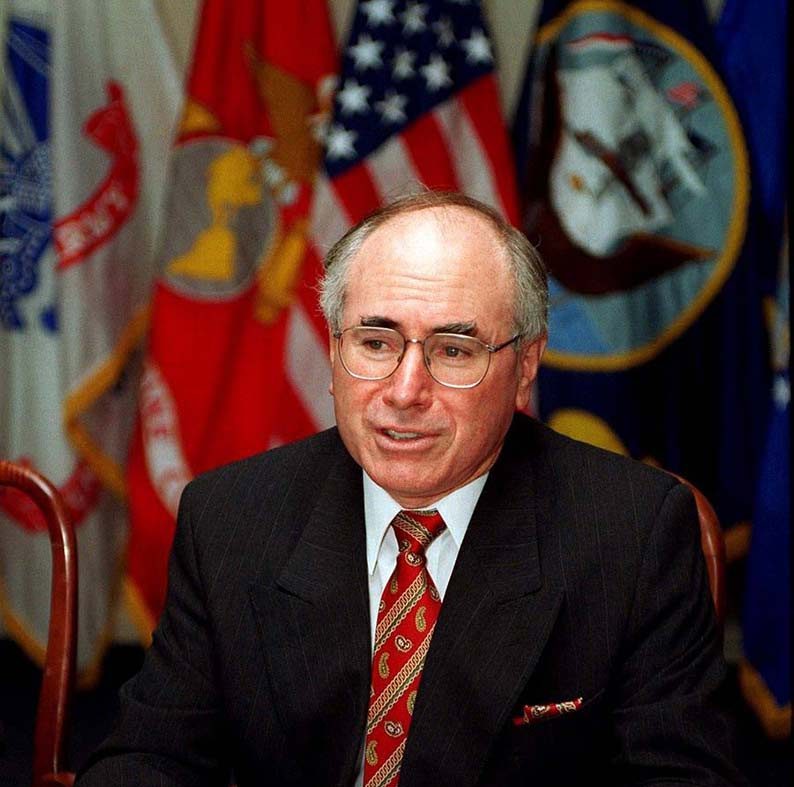

There are three past Novembers that continue to shape your working life, whether you remember them or not.
November 2005. John Howard’s government passes the Workplace Relations Amendment (Work Choices) Act through the Senate at two in the morning. By the following week, Greg Combet, then Secretary of the ACTU, stands before cameras and says “The Australian labour movement will overturn this legislation, no matter how long it takes.” Many doubted if the union movement had any steam left in it to fight this law.
November 2006. Thousands of people fill the Melbourne Cricket Ground. It is the largest union-organised gathering in Australian history. The crowd is not just unionists, it is nurses and teachers and retail workers and parents with children on their shoulders. The banners say “Your Rights at Work.” and this message is echoed by Greg Combet with his speech being heard by 300,000 Australians at rallies across the country “A new campaign starts today […] Your rights at work are not just worth fighting for […] they are worth voting for.”
November 2007. Howard loses government. He loses his own seat of Bennelong, only the second sitting Prime Minister in Australian history to do so. Hundreds of thousands of union members have staffed polling booths across the country in the largest non-party political campaign the country has ever seen. Combet was right. It didn’t take long at all.
Now cut to 2026. A Labor government that unions spent millions of dollars and hours to elect is in its second term, but real wages remain below their 2020 peak. Private-sector union density sits at 7.9%. The Fair Work Act, which replaced WorkChoices in 2009, still prohibits most strike action outside of narrow enterprise bargaining windows. Workers who take unprotected industrial action face fines of $12,600 per day. Union officials can be personally liable for millions. The right to strike in Australia is still, in practice, almost outlawed, and Fair Work keeps a lot of the same from WorkChoices — our industrial relations system continues to fall short of the basic standards set by the International Labour Organisation, with the rights of elected workplace delegates only now being improved in the most recent amendments to the Fair Work Act.
The question then is a simple one. How did the most successful union and political campaign in modern Australian history end with a movement that is smaller, still legally chained, and more reliant on institutions like the Fair Work Commission and the Labor Party than when the campaign began?

CREDIT: ACTU
Your Rights at Work was one of the most consequential
campaigns in the history of Australian trade unionism.
To understand what happened, you have to understand what WorkChoices actually was. When Howard’s government introduced the legislation in November 2005, it was not simply a new set of workplace rules. It was the culmination of a decades-long project to restructure the relationship between capital and labour in Australia. The legislation tore up the awards system that had set minimum conditions across industries.
It introduced Australian Workplace Agreements (individual contracts negotiated between employers and workers) that could legally undercut award conditions on everything except a narrow set of guaranteed minimums. It stripped unfair dismissal protections from workers in businesses with fewer than a hundred employees. It placed new restrictions on union official’s right of entry to workplaces. It expanded the Australian Building and Construction Commission (ABCC), a body with extraordinary coercive powers that operated effectively as an industrial police force for the construction sector.
It was, in short, the full business owner agenda written uncompromisingly into labour law that Howard and his friends had been dreaming of for decades. And it produced a political miscalculation of historic proportions. Howard had assumed, not unreasonably given the state of the union movement in 2005, that there was no longer the organised capacity to fight back. He was almost right.
What the ACTU built in response was something that had not existed in Australia for decades, a genuinely mass political campaign, rooted in community rather than just union membership. Researchers including Katharine Muir have documented how the campaign consciously reframed the terrain. WorkChoices was not just a union issue. The ACTU’s strategy positioned it as an attack on the rights of every working person, using the language of rights rather than the language of class or industry. Your Rights at Work. The framing worked and polling conducted during the campaign showed that voters who identified WorkChoices as an important issue and disagreed with it. Post-election analysis consistently identified YR@W as a decisive factor in shifting votes in marginal seats across Queensland, Victoria, and Western Australia.
The campaign deployed methods that Australian unions had largely forgotten. Coordinators were embedded in local communities, not just workplaces. Street-level organisers ran conversations with workers who had never been in a union and never would be. Advertising ran during prime time. Rallies filled city squares. On polling day in November 2007, hundreds of thousands of union members stood at booths from Cairns to Fremantle and handed out how-to-vote cards. And it worked. Howard was gone. Labor won a substantial majority and the union movement had put it there. Then the campaign stopped.

CREDIT: DEAN LEWINS/AAP
WorkChoices and the unions’ fervent campaign against it
were a critical factor in John Howard’s defeat in 2007.
This is the fact that demands explanation, because it did not have to stop, and it shouldn’t have stopped until workers got better laws then ever before. The movement that mobilised a nation in two years could not sustain pressure for two more years while the legislation was being drafted and passed. The Fair Work Act, when it came, retained almost all of the bones of WorkChoices, including: the protected-action ballot requiring workers to jump through a series of legal hoops before any strike action is lawful; the three-day written notice requirement before industrial action can commence giving notice for employers to prepare; the prohibition on pattern bargaining across enterprises, the strict limits on what industrial action can be taken on; the heavy personal penalties for any officials who dare step outside the narrow lawful window (basically, only whenever Jupiter is in retrograde).
Harry Glasbeek, the labour law scholar, called the resulting legislation “Rudderless in a Sea of Choices.” and he was being generous. The movement that had just spent two years telling Australians that WorkChoices was un-Australian then accepted a legal framework that preserved most of WorkChoices’ logic about what unions were allowed to do.
The problem is not just bad leaders, bad laws, or bad luck. The professional layer and paid officials of the movement did not sell out in the cartoon sense. They genuinely believed that pushing further was dangerous, that political capital needed to be banked rather than spent, that this was as much as could be won. That institutional judgment was not conspiracy. It was the settled worldview of a movement that had spent twenty years learning to be afraid of itself.
To understand the fear, you have to go further back. Not to 2005. Not to 1996, when Howard was first elected. Back to 1983, and the deal that remade Australian capitalism with the full participation of the union movement.
The Statement of Accord between the Australian Council of Trade Unions and the Australian Labor Party, signed as Bob Hawke took office, is usually taught as a pragmatic compromise. The story goes that unions accepted wage restraint in exchange for the social wage including Medicare, superannuation, improvements to welfare. Given the economic crisis of the early 1980s, the global turn towards globalisation and neoliberalism, and the growing disparity between pay and conditions between unionised workplaces and non-unionised one. So what choice was there but a stability pact for the good of the nation?
Elizabeth Humphrys’s scholarship in How Labour Built Neoliberalism reframes this entirely. The Accord was not a tactical compromise in a difficult moment. It was a consensual social contract through which the Australian labour movement was incorporated into a state-led project of neoliberal restructuring. The tripartite policy that embeds unions, industry, and government (workers, market and the state) directly into national decision-making is still a cornerstone policy of the ALP.
The unions did not have neoliberalism imposed on them, where unions were skewered for resisting like in the UK with the coal miners’ strike or the USA with the pilots’ strike. Australian unions helped to build our neoliberal project in the hopes of sparing themselves from the same fate seen in many other countries, and in doing so, they helped to build the conditions of their own decline.

CREDIT: SYDNEY MORNING HERALD
It is often argued that Australia’s neoliberal economic
regime was not set up by the Liberals and Nationals,
but instead by the Labor Party under Bob Hawke.
The mechanism was the “no further claims” clause. Under the Accord’s centralised wage-fixing arrangements, unions accepted fixed real wage increases in exchange for giving up the right to take industrial action over almost anything that fell outside the agreed framework. The effect that it had on shop-floor organisation was not slight nor gradual. It was devastating.
Without shop-floor bargaining over wages, delegate structures (the capillary network through which union power actually flows in workplaces) were decimated. Those structures had been built over decades of industrial struggle and organising. They were the accumulated organisational capacity of the Australian working class. The Accord did not just freeze wages. It destroyed the infrastructure through which workers organised themselves.
When some unions that refused to play along were dealt with, the blow came not just from employers or the government. It came from the ACTU and the movement itself.

CREDIT: SOLIDARITY MAGAZINE
In 1986, the ACTU supported the federal government’s
deregistration of the Builders Labourers Federation,
one of the most militant unions in Australian history.
The Builders Labourers Federation, which had a proud history of green bans and industrial militancy, was deregistered in 1986. When the federation resisted, the ACTU supported the deregistration. In 1989, Ansett and Australian Airlines pilots walked off the job in pursuit of a 29.47% wage claim outside the Accord framework. The Hawke government’s response was extraordinary. It mobilised the Royal Australian Air Force to fly civilian passengers and obtained court orders to dismiss the entire workforce. It was only the second time in Australian history that military assets had been deployed to break a civilian strike, the first being the 1949 coal miners’ strike also under a Labor government. The ACTU did not defend the pilots. It helped to isolate them, and to normalise the devastating tendency of union leadership in this country to sell workers out.
Queensland in this period had its own story that helped build fear and train the movement towards surrender. Under Joh Bjelke-Petersen’s National Party, Queensland’s anti-union apparatus operated without the minimal constraints that existed elsewhere.
The SEQEB dispute is the clearest example of this. In Febuary 1985, South East Queensland Electricity Board workers walked off the job over enterprise conditions. The Bjelke-Petersen government responded by declaring a state of emergency, ramming through special powers legislation, and instantly sacking over a thousand linesman — many of whom never recovered their jobs. The police presence was overwhelming, as was typical in Queensland during that time. The ACTU, already committed to the Accord framework, was in no position to organise national solidarity action — and so the SEQEB workers were left to fight alone.

CREDIT: THE BATTLER
The 1,007 SEQ Electricty Board linesman that walked
off the job for better conditions were hung out to dry
by the Queensland Trades and Labor Council.
The Queensland left that came of age in this period was shaped by this experience. The knowledge of what unconstrained capital can do when it has a compliant state apparatus, and the memory of what it felt like to be abandoned by union leaders and the movement as an institutional whole.
By the early 1990s, when the Accord’s centralised wage-fixing gave way to enterprise bargaining under Keating, the damage was already done. Enterprise bargaining replaced industry-wide solidarity with worksite-by-worksite negotiations. The metalworkers’ wage rise, which for decades had set the pace for the entire economy through flow-on effects in arbitrated awards, no longer moved anything beyond the factories where it was won. The solidarity mechanism was dismantled. Each workplace now bargained alone leading to vastly different conditions for enterprises that had decades of rolling EAs building up pay and conditions verses an enterprise that is on the skeleton base award of National Employment Standards (NES).

CREDIT: THE AUSTRALIAN
Accord Mark VI, reached under Paul Keating’s first term
as Prime Minister, introduced enterprise bargaining.
This is the world that Howard inherited in 1996. A union movement that had spent 13 years learning not to use its own power. Adelegate structure that had been hollowed out. A membership that had learned to think of unions as services rather than as organs of collective self-organisation. Howard did not create union weakness. He found it waiting for him, and he deepened it. WorkChoices didn’t come out of nowhere like a drunk driver. It was the completion of a project that the Accord had made possible. And the question it poses “why didn’t the movement fight back with everything it had?” cannot be answered without understanding that the movement that faced WorkChoices in 2005 was not the movement that existed in 1975. It was a movement that had spent two decades being trained to fear its own power, and only beg on its knees for the bare minimum.

CREDIT: NEWS.COM.AU
John Howard only had the confidence and capital to
implement WorkChoices because of the Labor leaders
who helped neuter the Australian union movement.
As Rosa Luxemburg put it in The Mass Strike: “With the psychology of a trade unionist who will not stay off his work on May Day unless he is assured in advance of a definite amount of support in the event of his being victimised, neither revolution nor mass strike can be made.” Clearly, we have not listened.
16 years is more than enough time to assess the Fair Work Act honestly. The legislation removed Australian Workplace Agreements. It reintroduced unfair dismissal protections. It created the Fair Work Commission as the central body for arbitrating industrial disputes. These were real improvements on WorkChoices, and it would be dishonest to pretend otherwise. But the structural architecture that made WorkChoices effective as a tool for suppressing union power was preserved almost intact.
The protected-action ballot regime requires workers to apply to the Fair Work Commission for authorisation before any strike action is lawful. The Commission can then delay balloting for up to 30 days. Once a ballot is approved and won, workers must give three days’ written notice before the action commences. The action must relate specifically to matters in the enterprise agreement being negotiated.
Secondary boycotts like solidarity action in support of workers in another enterprise or for political purposes remain prohibited. Pattern bargaining across enterprises in the same industry is prohibited. Right of entry to workplaces is governed by a permit system that can be subject to extensive litigation and give notice to employers.

CREDIT: LAWYERS WEEKLY
While Fair Work reversed some of the changes
made by WorkChoices, it still created and maintained
an incredibly strict workplace relations regime.
Workers who take action outside this narrow framework face fines of $12,600 per day. Union officials who organise or encourage unprotected action can be personally liable for fines reaching into the millions.
The Australian Building and Construction Commission was the industrial police force that Howard had built to control the militancy of the construction industry was abolished by Gillard in 2012, resurrected under Abbott in 2014, and abolished again under Albanese in 2022. The revolving door of an institution so politically useful to bosses (and Capital more broadly) that it keeps coming back to life because workers are limited in fighting it under our current system.
The most instructive recent data point is the CFMEU. The union movement campaigned in 2022 and 2025, donating millions of dollars and hundreds of thousands of volunteer hours, to return a Labor government twice. In 2024, that Labor government (with bipartisan support from the Coalition) placed the CFMEU’s construction division into five-year administration.

CREDIT: GLENN CAMPBELL/NEWSWIRE
Rather than wait for the courts to investigate alleged
corruption, the Albanese Labor government created
special legislation to place the CFMEU in administration.
The largest construction union in the country, placed under government-appointed administration by the party it had just helped to elect with laws and precedent on the books that could give a future conservative government the right to take over any union. The officials of the movement expressed shock. They should not have been shocked. This is the relationship plainly stated.
Elizabeth Humphrys foresaw this exhaustion as early as 2020, when there was talk of a new Accord. Her assessment was clinical, that the Accord had been so successful in disorganising the labour movement that it had removed the possibility of doing the same thing again. Without capacity in the trade unions, a new accord would be just a piece of paper. There is no longer enough shop-floor organisation to trade away. The Accord spent the capital that took decades to accumulate, and Your Rights at Work’s aftermath did not rebuild it. We are living through that exhaustion now.
Criticism without any direction is just complaint. We often hate when well-researched analysis does not have at least some takeaways, so here is what the history actually suggests, stated plainly for the people who can act on it:
Talk to everyone, even if they are not your members: a worksite where 40% are in the union, and 60% are not, is a worksite split in half with no solidarity — and those 60% are available to be used against the other 40. Talk to every worker on your site regardless of who’s already signed up. The conversation that brings someone in starts long before they fill out a form.
Focus on building a structure rather than a brand: the delegate network is the actual union, not the logo, not the campaign, and not the head office. Invest in training delegates, not producing glossy media. A workplace with only five trained delegates who know the agreement, get new workers into the union, and can work independently will outlast an organiser and a workplace with a branded campaign every time.
Bring the union into the very culture of the workplace, not just the contract: A union that only shows up when something’s gone wrong or it’s time to negotiate is merely a service, not a movement. Make union membership part of how the workplace operates day to day and get delegates to train the new starter, run the safety check, manage the group chats, and host local area meetings. Culture is built largely outside of disputes.
Carry the risk so your members don’t have to: The fines for unprotected action are real and they should not land on individual workers first. Build strike funds. Use the union’s legal capacity. The institution exists to absorb risk that an individual worker can’t carry alone — this is the whole point of paying dues.
Coordinate without waiting for permission to call it a campaign: pattern bargaining is illegal. Sharing information between worksites is not. Talk to organisers and delegates in other workplaces in your industry before the employer tells you what they’re offering somewhere else because you’ll already know. It also helps in building solidarity between delegates and organisers in different unions and helps knowledge sharing different tactics and what works and what doesn’t with different employers or industries.
Don’t wait for the union office to tell you to organise: organisers and unions are very busy and time poor, often a unionist’s first thought is to ask an organiser for advice or support but that is not needed. Start the conversations, sign people up, do a power analysis, run for delegate, read your agreement, research and practice organising firsthand before anyone’s tells you to. Workers are the union, not the organiser, so go ahead and build your union.
The Labor Party is a useful tool, but it is not a home: push the ALP when the government is moveable. Organise regardless of who’s in power. The CFMEU administration is a reminder that the party will act against the movement when it suits them. That’s not betrayal; if the media and polls are against a certain union they will let it out to dry, so if the ALP doesn’t do what your union wants… let them out to dry.
Hopefully these pieces of advice are such that any rank-and-file member, delegate, or organiser can act upon them.
Now, there is a statistic that deserves to be looked at to give some hope. Between 2022 and 2024, union membership among workers aged 15-25 grew by 53%. Among workers aged 25-34, it grew by 22%. These are not incremental increases, they are a generational shift in something that was supposed to be in permanent decline.
The workers that are joining unions now were not alive for the Accord and they were children or not yet born during YR@W. They have not lived through the defeats that made the institutional layer cautious. They do not carry the accumulated fear of 40 years of managed retreat. What they carry instead is the experience of a labour market, an economy, and a world that demonstrably does not work for them; by suppressing their wages, making housing unaffordable, creating job insecurity, the gig economy as an institution, all boiling over into growing conviction that collective action is the only tool that has ever changed any of it.
The shell shock of the Howard years is lifting. The open unanswered question that will be answered by the people reading this is whether the institutional fear that outlived Howard will be shaken off. Whether the movement that once filled the MCG will remember that filling the MCG was not the point. The point was what came next. What happens at the workplace on
Monday morning. Whether the delegate is there, whether the enterprise agreement is understood, whether the workers in the tea room are having conversations, and if the workers realise their collective power and that bosses are not needed.
This article is not a complaint about the unions we have. It is an argument that the unions we should have are within reach. The Accord made a movement that was afraid of its own power. YR@W briefly remembered what that power felt like, and then forgot again. The forgetting is not inevitable. It is a choice, and it is one that the generation now joining unions has not yet made.
Three future Novembers is all it takes to shape your working life. What you do with them is up to you.
-30-
This article was originally published in Keep Left #2.

Leave a Reply