
Labor has recently, finally, changed negative gearing and the capital gains discount, exorcising Australia of the spectre of John Howard that has haunted the housing market for 30 years. Labor’s changes, however overdue, are a win which must be celebrated, but they are a (admittedly large) drop in the bucket when compared to Labor governments of the 20th century dealing with their own housing crises. You wouldn’t think that from the mainstream media’s screaming and howling, crying “Communist Albo!” while editorials and op-eds share the sad plight of the landlord.
Conservative mainstream media consistently blames high immigration and falling construction productivity due to union activity, red tape, a lack of innovation, or a combination of all of them. Meanwhile, more liberal media outlets point fingers at interest rates, supply, and, yes, taxes. Often, news outlets compare today’s crisis to that which gripped Australia after WW2. In that narrative, it goes that the postwar federal Labor government under Chifley gave money to the states to establish Housing Commissions to build homes.
Then, under the Liberal-Country coalition begun by Menzies, the private construction industry bloomed, with companies innovating new technologies to build quicker, builder migrants (white) arriving on Australian shores, and houses built en masse with plenty of land supply and few regulations. In the 50s and 60s, public houses were sold to their tenants and Australia’s rosy high watermark of housing ownership was reached at 71%. It’s a neat story, but it’s missing something; the half-dozen socialist and progressive policies that lasted well into the latter half of the 20th century.
A good news outlet may bring up the first principle in the Commonwealth Housing Commission’s 1945 report to Labor Prime Minister Ben Chifley, which was that “a dwelling of good standard and equipment is not only the need but the right of every citizen.” An inspirational statement to be sure, but less repeated are the other principles and findings of the report, which concluded that “private enterprise […] did not supply a sufficient number nor a reasonable standard of dwellings.” i.e., private enterprise got us into this mess, and it needs government to get Australia out of it. This was the real birth of Australia’s housing golden age.
Price controls. It’s a fraught term today, criticised as blunt (perhaps for good reason) and ineffective (perhaps not for good reason), but price controls were put in place everywhere to kickstart the housing boom. Knowing that the renting vacancy rate was low, the Labor NSW Housing Minister said in 1948 that without rent controls in a tight market, “there would be wholesale eviction of householders, with attendant misery […] rents would spiral.” He also stated that increasing rents for commercial tenants would more widely drive up the cost of goods everywhere. Could you imagine.
Based on a national definition of an affordable rent being 15% of a household’s income, the Landlord and Tenant Act 1948 (Qld) put rent price controls on all buildings, residential and commercial. Landlords were limited to approximately a 5% return from rented property. It imposed heavy restrictions on the reasons landlords could end a tenant’s lease, and, if they did, it was the landlord’s responsibility to find alternative accommodation for the tenant. In Queensland, if a landlord wanted toraise rents, they had to go to a “Fair Rents Court” with the tenant, and so as to not financially burden a tenant, they could not bring a lawyer. In 1968 the new Liberal Premier neutered the Act, however rent controlled private leases were still being created up until 1986. These rules were similar around Australia, and played out the same: socialist housing policies were built by Labor and knocked down by Liberals.
Landlords and developers tried to capitalise on the future housing boom, and began furious land speculation. In response, the price of land was capped, and the price homes could be sold at was also capped. It’s a hard task to compare incomes and housing prices over 80 years, but homes were capped at a price roughly four times the annual average wage. Price controls were also used to control the prices of construction materials, which after WWII exploded due to scarce supply and profiteering. When construction companies protested, closing their factories in order to exacerbate supply issues and force prices (and profits) higher, the states passed laws granting themselves powers to direct businesses to produce, supply and sell mandated amounts of goods within a certain timeframe, or face fines.

CREDIT: STATE LIBRARY OF NSW
Between 1947 and 1961, housing stock in Australia grew
by around 50%, totalling over 920,000 new homes.
This is something we might consider today as being more along the lines of the Soviet Union than of Australia, but it worked in increasing supply and lowering costs of construction materials, and continued into the early 1950s. While the most extreme price control measures were dropped by the early 1950s, this approach ramped up production of materials immensely, and gave private enterprise confidence that demand would remain high after the near total ban on residential construction during the war.
Laws were also passed in most states after the War that introduced a permit system which prohibited the construction of luxury or holiday homes to ensure that all houses built were to be lived in. The permit system prioritised cheap homes to curb builders constructing expensive dwellings. It was recognised back then that when developers and builders have a choice between building a luxury home or an affordable home, private enterprise will always build the most profitable dwelling. After all, a basic three bedder costs almost the same to build as the “luxury” home.
By 1945, Labor governments had had long experience fighting capitalist sabotage against their aims of improving the lives of ordinary people. As such, whether it was to improve competition in the market, give employees more decision making power in their workplace, or simply providing better services for Australians, Labor spent the first half of the century repeatedly creating government owned businesses from the ground up to meet the needs of Australians. Broadly, this included fish shops, butchers, and petrol stations, to combat the cost of living, but these Government Business Enterprises (GBEs) were also important in Australia’s housing boom. Across Australia, into the 80s, there were state owned sawmills, forestries, brick factories, prefabricated housing factories, joineries, and more. Governments also constructed empty factories with rail, road, and power connections, to lower capital investment to support the private construction industry. All contributed to the lowering of the prices of materials and the cost of construction in Australia’s housing boom.
Government owned banks gave generous loans to Australians that private banks were too scared to touch — owner builders, building societies, and low income earners. In fact, owner builders were responsible for the construction of a third of all homes between the 40s-60s. Today, banks still won’t touch an owner builder unless they can put down a 50% deposit or more. Similarly, the Housing Loans Insurance Corporation was an invention of then Prime Minister Robert Menzies, whose other well known invention was the Liberal Party.
The HLIC gave Australians an option to pay a smaller deposit in exchange for paying lenders mortgage insurance. That money went to the Government, in public hands to be reinvested for the public good, and satisfied banks that the loans were secured. Compare that to Labor’s 5% deposit scheme, which in exchange for an even smaller deposit…. Australians get to take out a 95% loan, add fuel to the housing market fire, and give more money to banks through the extra interest, via a loan Australia is on the hook for. A win-win, if you’re a bank. The HLIC, which was mostly profitable and increased publicly-owned wealth, was sold off in 1997 by John Howard. It’s a sad day when Labor’s policies are less imaginative than the Liberals of 60 years before.
And the pièce de résistance. The Housing Commissions, embedded into Australian (sub)conscious, an incredible achievement and legacy of the Labor Government that brought Australia through World War II. Around a quarter of all homes in the post-war era were directly built by governments around Australia. The 1945 Commission gave the states responsibility for the provision of housing, with the Commonwealth responsible for the financing. The Commonwealth gave billions of dollars in low interest loans to the states in return for their agreement to the federal housing plan, which told states to create their own Housing Commission to construct thousands of homes and put up tenants that would not pay more than 20% of their income on rent.
Public housing was not simply for housing the poorest of the poor, instead families of various incomes lived in the same neighbourhoods in public housing for years and decades. The first federal housing plan included provisions that disincentivised selling off public homes. After all, as then-responsible Labor Minister John Dedman put it, the government was “not concerned with making workers into little capitalists.” Public housing was to remain public, to remain as affordable housing for everyone, and to remain as a competitive alternative to the extortionate private landlords.

CREDIT: WIKIMEDIA COMMONS
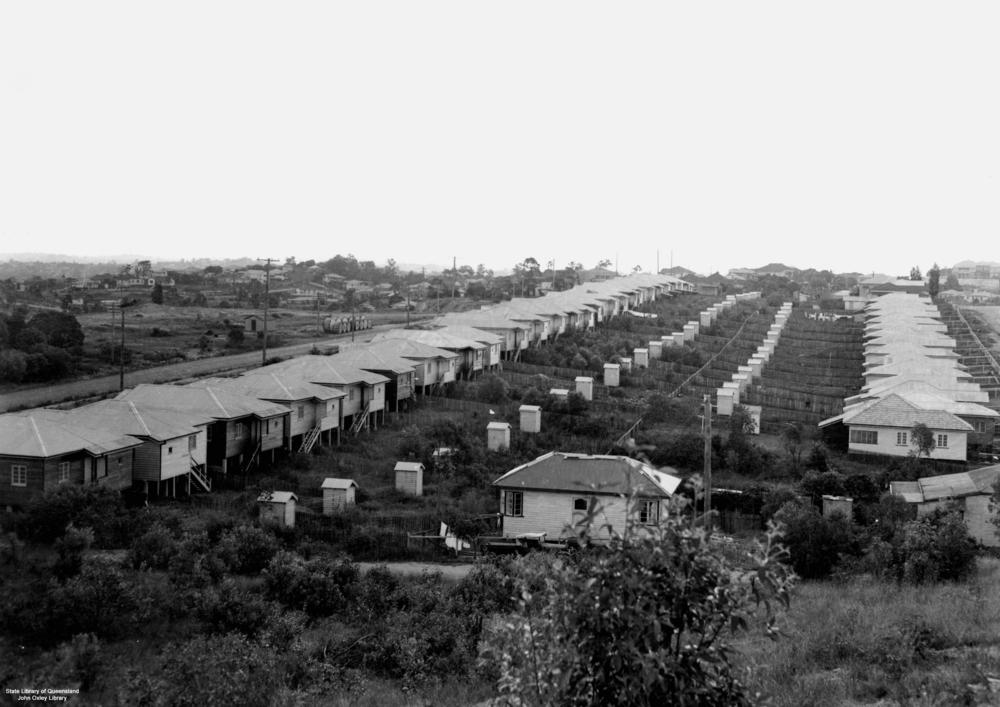
The character of post-war Brisbane suburbia was
heavily shaped by the standardised home construction
of the Queensland Housing Commission.
While those home purchase provisions didn’t survive more than 7 years (scrapped by our old friend Menzies), it reveals a glimpse of the socialist fight and ambition of the Labor Party of yore. Over the next 50 years, entire suburbs were built by state governments Australia wide. Today, I rent a home in Inala, a suburb that was entirely housing commission and sold off in the 80s and 90s. In those decades at least, the money from selling the homes subsidised the construction of more homes, until that at last stopped in the 1990s.
We know these methods worked. While the ABC’s 2023 housing explainer reported that Menzies was boasting about his construction record in 1954, the Sydney Morning Herald of 1953 was reporting on the plight of the landlord, bemoaning the fact that rents had only gone up 18% in 15 years due to rent controls. They wrote that the fact that rents had remained so low compared to other goods meant that “property-owners have been obliged to subsidise the cost of living. They have contributed not only to their tenants’ incomes but also to the whole basic wage structure.” More progressive readers might have thought that was the entire point.
The Sydney Morning Herald in 1953 made the same argument heard time and time again today, that price controls, legislation that favoured the tenant, and taxes, are curtailing the housing industry. History tells us the opposite. Labor’s tax change announcements this year are phenomenal, but years overdue, and were held back by the same media who have made the same articles for a century. Coming out of a world war gave the 1945 Labor government a huge amount of political capital to make big sweeping changes in Australia, and could, for a short while, take less heed of what the capitalist media said.
But even if modern Labor governments might view its own historical policies as outdated, too difficult, or unpalatable in elections, the proof that they worked is there, and future Labor policies should ensure they meet the same criteria. They must give confidence to private enterprise, twisting their arm with a vice grip if need be, that a housing boom will continue for decades, and spur spending of the private sector’s own hoarded capital. At the same time, the billions of dollars of public investment that are required cannot be handed out in a massive wealth transfer to developers and the very rich. It must increase the wealth of the government, and increase the wealth of ordinary Australians.
There was another conclusion in the 1945 report that is telling: “it is impossible to separate housing from a consideration of the broader aspects of the life of the people.” The Labor Party (or, to be precise, the tireless socialists in the unions and in the Party) knew that if they wanted to genuinely transform the lives of ordinary Australians for the better, it needed to make changes across all of society. They built better schools, publicly owned third places, and awarded workers the greatest rights in history. During and for years after the war, that belief was so strong that the federal government, and then the states, capped and controlled the price of groceries. Something to think about the next time you go to Coles.
-30-
This article was originally published in Keep Left #2.
Leave a Reply